Showing posts with label Animals and Reptiles. Show all posts

Wednesday

Coyotes - vs Wolves or Foxes

{Click on any image to view full size, then use the back button on your browser to return to this page}
This page last updated on 02/23/2020
(Fig. 01)
Picture Notes: The pictures in (Figs. 01-03) were taken on 01/29/2020 off Kingman Wash Road and Fortification Hill Road in the Lake Mead National Recreation Area, about 2 miles over the bridge into Arizona. Here is the page for the place where we took these pictures ... Fortification Hill Road. Because I forgot my camera today, my friend Jim Herring, shot all of the pictures shown here. It is difficult to differentiate the difference between Coyotes and Wolves. You decide. In all of my hiking I have only seen coyotes on three occasions. The first time was while driving Bitter Spring Backcountry Byway Road. The last three pictures (Figs. 05-07) were the two coyotes we spotted near Bitter Spring. Here is the page for the place where I took these pictires ... Bitter Spring Backcountry Byway.

(Fig. 02)
Description: Coyotes vs wolves and foxes. It may be challenging to spot the difference between a coyote and a wolf or fox because of their similarities at a glance. But, looking closely, one would firstly notice that coyotes are much larger than the foxes. Coyotes are larger than foxes but are smaller than the wolves. Unlike a wolf, a coyote has a bushy, thick tail, which it holds low to the ground. Coyotes hunt primarily in pairs, while wolves hunt in packs. As a point of interest, the animals we observed today were three hunting food together. Based upon the descriptions below, I think these are wild Coyotes. 

Coyotes can weight from 20 to 46 pounds and have a long snout with triangular ears. They are larger than foxes but smaller than the wolves. Coyotes average 24 inches tall at the shoulder and, including the tail are approximately four feet in length. Coyotes in the desert average about 20 pounds, while those found in mountainous areas can average twice that. Females are slightly smaller than males. The coat is predominantly gray, changing to tan along the belly, legs, muzzle and ears. Some guard hairs, as well as the tail are tipped with black. The intensity and amount of coloring varies and individuals are usually lighter in the winter. The legs of a coyote are visibly thinner than those of a wolf. Coyotes can hunt during the day. Wolves generally have gray, black, or white fur and are bigger in size than the coyotes.

In general their habitat range from the low desert valleys to the alpine ridges. Coyotes are found in about any type of habitat where they can find food and a place to hide. They seem to show some preference for brush covered rolling hills and flats. Coyotes have perhaps the most varied habitat of any animal in Nevada. The coyote is an opportunistic feeder. In most areas of Nevada, rabbits, rodents and carrion make up the bulk of the coyote diet. Coyotes in urban areas forage at landfills and raid garbage cans and have been known to take domestic dogs and cats.

(Fig. 03)

(Fig. 04)
(Fig. 05)
(Fig. 06)
(Fig. 07)

_________________________________________________

Note: Every attempt is made to provide accurate information, but occasionally depictions are inaccurate by error of mapping, navigation or cataloging. The information on this site is provided without any warranty, express or implied, and is for informational and historical purposes only.


Monday

Index for Category – Animals and Reptiles

This page last updated on 02/20/2020
Click on a Title to View

BURROS - Index (5 posts)
COYOTES - Index (1 posts)
DESERT BIGHORN SHEEP - Index (15 posts)

DESERT TORTOISE - Index (3 posts)

LIZARDS - Index (10 posts)

RABBITS - Index (5 posts)

SNAKES - Index (3 posts)

WILD HORSES - Index (14 posts)

VARIOUS OTHER
      Painted Turtle (Chrysemys picta)
     Tarantula (aphonopelma)

Tuesday

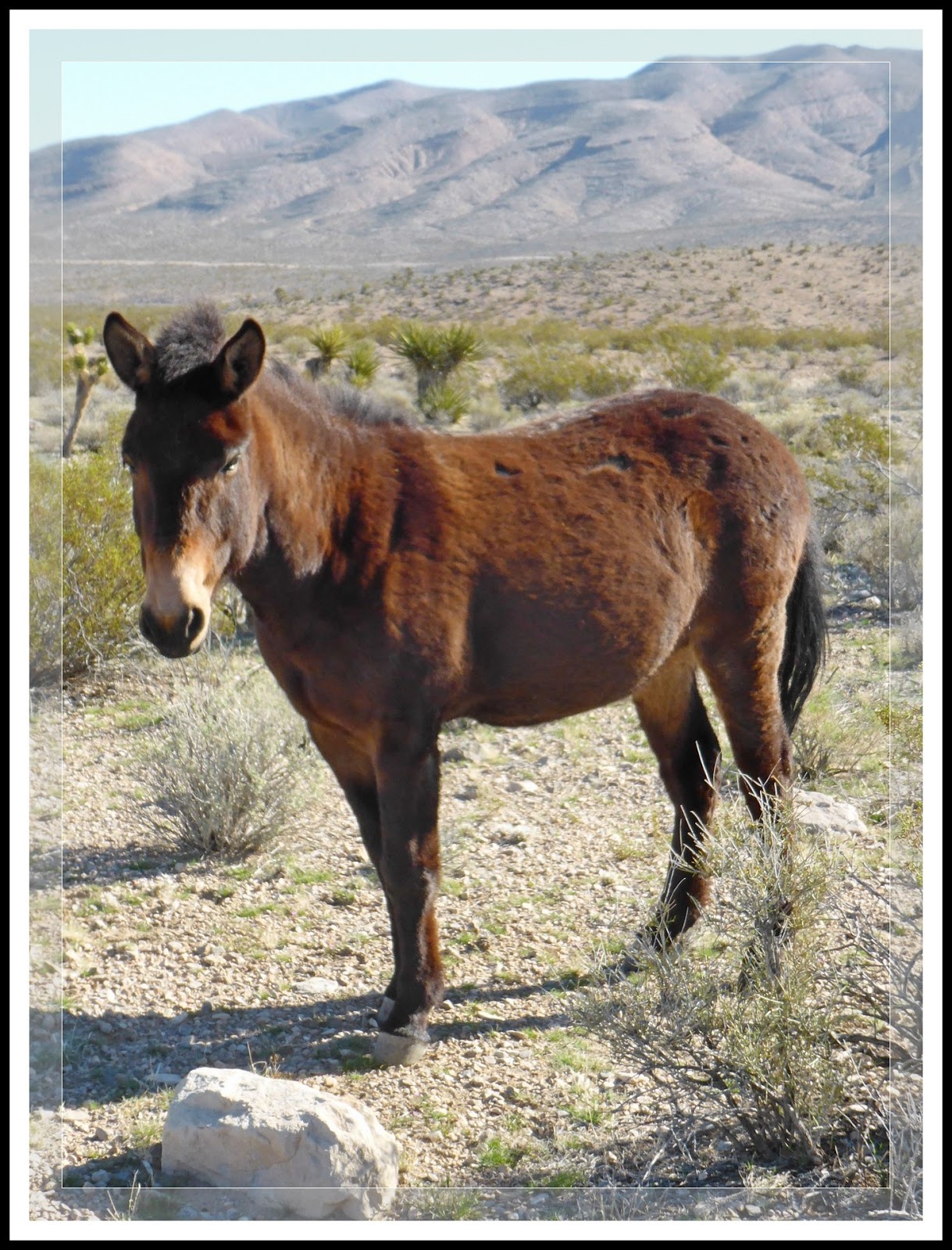
Mule (Equus Mule)


(Fig. 01)
Picture Notes: The picture of the Mule in (Fig. 01) was taken on 03/18/2016 while hiking around Goodsprings Valley behind the town of Goodsprings, Nevada.  The pictures of wild Burro in (Fig. 02) was captured on a drive through Red Rock Canyon Park. For more on these Burros go to ... Wild Burro (Donkey) - (Equus - asinus).


Description: Because Mules do not constitute a species, there is no scientific name for mules as a species. The reason mules are not considered a species is because mules do not reproduce - they are hybrids, the offspring of a male donkey (called a jack) and a female horse (called a mare). Mules are almost always sterile (except that, on rare occasions, a female mule can be fertile).
Mules inherit desirable qualities from both donkeys and horses; from the horse they inherit strength and stamina, and like donkeys, mules are generally patient, sure-footed, intelligent and have an even temper. Donkeys have long ears, a short thick head, a short mane, thin limbs and narrow hooves (Fig. 02). Mules share these characteristics with donkeys but they are larger and taller than donkeys. The physical characteristics that mules share with horses include shape of the body, a uniform coat, and teeth (Fig. 01). The hooves of a mule are harder than those of a horse. The coat of a mule is usually brown (sorrel). Mules have longer ears than horses but usually somewhat smaller than donkey.

Mules have several advantages. Mules have tougher and less sensitive skin than horses. They can live as high as 50 years when compared the the horse's 30-ish years. They need less food, pound for pound, than horses due to a much more efficient digestive tract. Pound for pound mules are also stronger than horses and have a better stamina and agility. Because they are typically much larger than donkeys, they can carry a greater weight. Mules don't spook as easy as horses do and have a strong "self preservation" sense making them a better companion in a fight with wild animals. Finally, mules endure heat and lack of water much better than horses, and are built more for desert life.

Major differences between a wild burro (Donkey) (Equuis asinus) and a Mule: The main difference between a donkey, mule, and a horse is genetics. Beyond the genetic difference, you can easily tell the difference between a donkey and a mule by a few different physical markers. The easiest thing to spot is that mules are usually larger than donkeys (often significantly so), much more closely resembling a horse in size. Another easy difference to spot is that, in the summer, a mule’s coat tends to more closely resemble a horse’s, rather than the longer, coarse hairs of a donkey. However, in winter mules tend to develop coats that more closely resemble a donkey. Besides physical and genetic differences between a mule and a donkey, you can also tell the difference just by hearing them make noises. Donkeys make a very distinctive hee-haw type sound. Mules make a sound that is something of a cross between a horse’s whinny and the donkey’s hee-haw, often starting as a whinny and melding into a hee-haw.
                  

Western Sagebrush Lizard (Sceloporus graciosus gracilis)

(Fig. 01)


Picture Notes: This picture (Fig. 01) was taken while on a hike to the La Madre Spring in the middle of the La Madre Wilderness Area, inside the Red Rock National Conservation Area. We were at an elevation of nearly 5,500 feet, hiking along the rocky sides of the stream that flows from the La Madre Spring.
                                 
Description: I believe the picture above is a Western Sagebrush Lizard (Sceloporus graciosus gracilis). It is a small lizard, generally, 2 - 3 1/2 inches long from snout to vent. It has small keeled and pointed scales overlapping on the upper surfaces of the body and limbs. These scales are not as large as they are on other lizards of the genus Sceloporus. The scales on the back of the thigh are mostly granular, not keeled (as they are on the Western Fence Lizard.) Their color is gray or brown with dark blotches or irregular bands on the body and tail. Stripes on the sides, visible on other subspecies of Sceloporus graciosus, are not distinct, being reduced to rows of blotches or only partly connected blotches. There is usually a bar of black on the shoulder and rusty coloring on the armpits and sometimes on the sides of the body and the neck. Active spring through fall, they hibernate during winter. They are a good climber and jumper, able to quickly jump from rock to rock. Living mostly on the ground near bushes, logs, rocks, or brush piles, and logs, they are often observed basking on rocks and logs. They eat a variety of small invertebrates, including ants, termites, grasshoppers, flies, spiders, and beetles. Sagebrush Lizards are usually found at higher elevations and may even be found in juniper-pine woodlands with brushy understory. Their range is from eastern Washington to Wyoming, south to southern Nevada, northern Arizona and northwestern New Mexico.

Thursday

Black-tailed Jackrabbit at Ash Meadows

         {Click on an image to enlarge, then use the back button to return to this page}
Rabbit Diptych_thumb[3]
Picture Notes: On 10/29/2015 to the Ash Meadow National Wildlife Range, the only real sign of wildlife was a Black-tailed Jackrabbit, even though I was unable to capture a picture. Other than a few birds, a variety of waterfowl on the Crystal Reservoir, and the occasional small desert lizard, this jackrabbit was the only other sign of wildlife we spotted all day. I didn’t even see any desert chipmunks.  I was wondering if last weeks heavy rain and floods was the reason wildlife was so scare on this visit.
                                    
Description: The Black-tailed Jackrabbit (Lepus californicus), commonly known as the American Desert Hare, is native to the western United States and Mexico. Its ears have a black patch at the tip and are nearly as long as the hind foot. The top of the tail has a black stripe that extends onto its rump, The under-parts are usually clear; upper-parts have a dark buff, heavily sprinkled with blackish hair.  It can reach a length of about 2 feet and weight between 3 to 6 pounds. It is the third largest North American hare, after the antelope jackrabbit and the white-tailed jackrabbit. The black-tailed jackrabbits occupy mostly mixed shrub-grassland terrains. They typically bread in the spring, but depending upon location may continue all year round in warm climates. Their young are borne fully furred with eyes open. Because they are well camouflaged and mobile within minutes of birth, the females do not protect or even stay with the young except during nursing. Average litter size is around four, but may be as low as two and as high as seven in warm regions. They grow rather rapidly and reach adult size in about 7 or 8 months. The black-tailed jackrabbit does not migrate or hibernate during winter and uses the same habitat of between .5 and 1.5 square miles year-round. Its diet is composed of various shrubs and small trees during fall and winter months and grasses and forbs in spring and early summer. The natural enemies of rabbits include the larger birds of prey and such carnivores as coyotes, foxes, bobcats, badgers, and weasels. When molested it depends on speed and its keen senses of hearing and sight to elude its enemies.

Saturday

Desert Bighorn Sheep at Valley of Fire

EFP-P1110202
04/23/2015 Trip Notes: After returning from a hike to the Fire Wave via the Kaolin Wash back to Mouse’s Tank Road on the northern end of Rainbow Vista we encountered three bighorn sheep that were grazing just a few hundred feet off the road. Even though there were at least 10 of us that got off the van to take pictures, they hung around just long enough for me to capture these shots (Figs. 01-03) before they scampered (Fig. 04) off into the rock cliffs.
EFP-P1110209
EFP-P1110200
EFP-P1110207
 

Desert Tortoise Finding near Nipton, California

EFP-P1110303
04/29/2015 Trip Notes: While on a daytrip to the Lucy Gray Mine, northeast of Nipton, California, Harvey and I came across three instances of Desert Tortoise crossing the road. In all the hiking we have done over the past several years, this is the first time we have come across a live Desert Tortoise in their natural environment. To see three of them in the same day was just amazing. Even though I am aware that tortoises come out of brumation, a semi-hibernation state, in March or April as the weather warms up, I was surprised to find three of them within a two mile distance. The first one we came across (Figs. 01 & 02) was a little shy and we had all we could do to coax it to stick its head out once he became aware of our presence. Our second sighting (Figs. 03 & 04) was a little more active, and actually continued to scramble across the road and into the shade of a creosote bush. One thing I noticed was that all three had loose dirt on the top of their shells. Because it was quite breezy, I determined that they had only recently climbed out of their burrows, else the loose sand on their backs would have been blown away by the wind. Though I didn’t notice until I got back and started editing the day’s pictures, the third tortoise (Fig. 05 & 06) had a unique man-made marking on the rear of its shell. It was only recently I learned, during construction of the nearby Ivanpah Solar Electric Generating System  located just a few miles west of this location, that they spent more than $30 million on tortoise protection measures, eventually finding and relocating more than 170 tortoises. My guess is that they may have “marked” the tortoise that they relocated back into the desert for future observation purposes, and if so, this could be one of them and why we found so many in this area. For more info on this endanger species check out my page ... Desert Tortoise (Gopherus agassizii).
                             
EFP-P1110302
EFP-P1110309
EFP-P1110313
EFP-P1110314
EFP-P1110316
Click here to return to the [Lucy Gray Mine Page]

Wednesday

Desert Iguana (Dipsosaurus dorsalis)

EFP-P1110257
(Fig. 01)
Picture Notes: After finishing the Fire Wave hike, Blake and I went back and hiked the Mouse’s Tank trail. On our way back we spotted this Desert Iguana (Fig. 01) frolicking in a large bush on the side of the trail. He was quite busy climbing around this bush (Fig. 02) looking for and eating buds and berries (Fig. 03). Occasionally he would look our way if there was movement (Fig. 04). Even though more than a half dozen hikers gathered around to take pictures, he continued foraging for food, remaining undaunted by their presence.
                               
Description: The Desert Iguana (Dipsosaurus dorsalis dorsalis), is one of the most common lizards, and also one of the biggest. Their preferred habitat is creosote bush scrubland, where they feed on the green plants of the area. They are widely distributed throughout the Mojave, Sonoran and Colorado deserts, typically below 3300 feet. It is found in greatest abundance in sandy creosote flats but can also be found in rocky or hilly areas. They can withstand high temperatures, and are out and about after other lizards have retreated into their burrows. They are very quick critters and can run at high speeds on their powerful back legs, curling their tail over their back and folding their front legs into their body.

The Desert Iguana is a medium-sized (10-16 inches), light colored lizard with a long tail. Its snout-vent length can measure almost six inches, and its tail nearly 1 1/2 times longer. It has a small, rounded head with large ear openings, and sturdy legs. Broad dorsal bands span its light cream colored body, and eventually become rings around its tail. Narrow, longitudinal stripes overlay the dark bands, especially in the central and posterior dorsal areas. The bands and stripes occur in various shades of brown and gray. The dorsal scales are keeled, and become slightly larger down the center of the back. This forms a well-defined crest that extends along the back and diminishes down the length of the tail.
                         
They like sandy desert flats and washes. These habitats also provide sandy, friable soil that is necessary for burrow construction. Primarily herbivores, they eat the flowers, buds, fruits and leaves of many annuals and perennials, especially creosote. Some individuals have been observed to climb up 6-7 feet into a bush to forage. This one was about four or five feet up into this bush. They are particularly attracted to yellow wildflowers, and seems to prefer the yellow blossoms of the creosote bush often climbing the branches to reach the little flowers. Their activity consists largely of foraging, moving from one food plant to the next and eating. Most of the time on the surface is spent basking in the sun on hummocks near burrows or in bushes.
                                        
EFP-P1110261
(Fig. 02)
EFP-P1110265
(Fig 03)
EFP-P1110269
(Fig. 04)

Friday

Wild Burro (Equus asinus) – Red Rock Canyon

{Click on any image to view full size, then use the back button on your browser to return to this page}
EFP-P1080033
(Fig. 01)
09/17/2014 Trip Notes: Out of the dozen times that I have visited this area, I have only spotted burros on three occasions. I attribute the fact that we spotted 6 burros on today’s trip to the time of day. I don’t think I have ever visited this area this close to sunset before. We spotted these burrow along Blue Diamond road as we were headed back to highway 160 on our return home. I'm not sure if this is breeding season, but the burro in (Fig. 01) appeared rather young. Notice that the burro on the left in (Fig. 04) appears to be pregnant.
                         
EFP-P1080023
(Fig. 02)
EFP-P1080030
(Fig. 03)
EFP-P1080026
(Fig. 04)

_________________________________________________________________
EFP-P1070737
(Fig. 05)
08/09/2014 Trip Notes: I spent the morning hiking trails in Willow Springs Canyon taking pictures of petroglyphs and pictographs. On my way out of the park, I came upon this lone burro (Fig. 05) munching on the grass. Luckily, I was able to work my way around him to capture a picture with the mountains in the background (Figs. 06 & 07), before he scampered off. In all of my visits here, this is only the second burro sighting I have had inside the park, the first being about eight years ago.
          
EFP-P1070743
(Fig. 06)
EFP-P1070742
(Fig. 07)

Great Basin Whiptail (Aspidoscelis tigris)


{Click on any image to view full size, then use the back button on your browser to return to this page}
EFP-P1070683
(Fig. 01)
Picture Notes: On 08/09/2014, while hiking near the Willow Springs Picnic Area inside Redrock Canyon looking for some pictographs, I spotted a Great Basin Whiptail lizard (Fig. 01) in some brush ahead of me attempting to capture a caterpillar. He spent the first couple of minutes sizing up his victim (Fig. 02) before actually latching on with a big bite (Fig. 03). When I attempted to move closer for a better shot he scurried off. Climbing up and around a large boulder, I found him wrestling its victim in an open area of the rock.  As seen in the next series of photos (Figs. 04-07), he then spent the next 10 minutes wrangling in and devouring this tempting morsel. As you can see in (Fig. 06), he is sucking every last ounce of “juice” out of him. Having nearly completed this huge meal, notice in (Fig. 07) how much fatter his body appears.
                               
EFP-P1070679
(Fig. 02)
EFP-P1070680
(Fig. 03)
EFP-P1070687
(Fig. 04)
EFP-P1070691
(Fig. 05)
EFP-P1070692
(Fig. 06)
EFP-P1070694
(Fig. 07)
Description: Great basin Whiptail (Aspidoscelis tigris) as a species is slim-bodied with a long slender tail, a thin snout, and large symmetrical head plates, and can grow to 2 3/8 - 5 inches long snout to vent, and up to around 13 inches total length. Depending on the individual, Western Whiptails may appear to have a light ground color that is marked by a dark reticulated pattern, or they may appear to have a dark ground color that is marked by numerous light colored spots. Regardless, there is always a striped pattern down the full length of their body that is apparent. The four stripes are a light tan, gray or cream color and extend dorsolaterally from the base of the head towards the tail. The stripes are most prominent in juveniles, and they tend to fade posteriorly in adults. The previously described pattern of contrasting spots and markings extends onto the base of the tail, but the color darkens towards the tip, becoming a more bluish-gray. Western Whiptails have fine, granular scales dorsally, and large rectangular scales arranged in 8 rows ventrally. The lower limbs of these lizards have a distinct scalation, being covered anteriorly with large, smooth scales that contrast with the granular scales elsewhere on the limbs. In fact, the genus name loosely translated means "bearing armored legs". The long tail of the Western Whiptail can be more than twice the snout-vent length if it is unbroken. There is a fair chance that a Western Whiptail may be encountered with a tail that is regenerating, as they will readily lose their tail to predators and would be captors.
             
Western Whiptails mate in the spring, laying 1-4 eggs in June or July, which in turn hatch in August. The juveniles resemble the adults but are more vividly colored (including the tail, which is more blue in coloration). The back and sides are grey, tan, or brown, marked with dark spots or bars or mottling, which is often very sharply defined. Dark marks on the sides often form vertical bars. The belly is made of large, smooth, rectangular scales in 8 lengthwise rows. Often there are reddish patches on the sides of the belly. The throat is pale with with obscure black spots. Scales on the back are small and granular, and scales on the tail are keeled. The tail can reach up to two times the length of the body. They can be wary and very active, moving with abrupt stops and starts with side-to-side head movement and tongue flicking. Often seen digging rapidly when foraging. Typically foraging near cover, they are very difficult to approach and are capable of quick bursts of speed into heavy brush or holes. They like to eat small invertebrates, especially spiders, scorpions, centipedes, termites, and small lizards.
                 
The species (Aspidoscelis tigris) ranges from North central Oregon and southern Idaho, south through California and Nevada to Baja California, and east into Utah, Colorado, Arizona, New Mexico, and west Texas. From sea level to 7,000 feet, they are found in a variety of ecosystems, primarily hot and dry open areas with sparse foliage - deserts, chaparral, sagebrush, woodland, and riparian areas. They generally avoid areas with dense growth.


Tuesday

Desert Bighorn Sheep along Lake Mojave

EFP-P1070597
                             
07/22/2014 Picture Notes: My most recent sighting of Bighorn Sheep was along the banks of Lake Mohave at it passed by the Eldorado Canyon area. Having launched from Willow Beach Marina, we made a six hour boating journey took us more than 30 miles up and down the river. On our return to the marina from the southern leg of the journey, this spotting occurred around 2:00 pm in the afternoon near a location known as Nelson’s Landing. Though the literature for the area notes the opportunities for seeing Bighorn Sheep, this was the only sighting we had all day. This flock of seven sheep is one of the largest groupings I have encountered.  Click here to read more on these animals … Desert Bighorn Sheep.
                               
EFP-P1070603
EFP2-P1070602

Wednesday

Painted Turtle (Chrysemys picta)

EFP-P1050994
(Ref. 01)
Picture Notes: I took these pictures on 01/16/2014 while visiting Rogers Spring, a colorful desert oasis located along Lake Mead’s North Shore Drive. I spotted two of them swimming in the small, warm water, spring fed pond found here (Fig. 05). There are many unusual fish and turtles that live in the pond. Many of the fish found here were imported by the former private owners of the land in and around Rogers Spring to sell the fish to pet stores. Because of this, it is highly unlikely that neither the fish nor turtles are indigenous to the area. There are molly's, guppies, ciclids, and more. If you look closely to some of these pictures, (Figs. 01 & 04), you can spot some of the fish swimming around the turtles.
                          
EFP-P1050999
(Fig. 02)
Description: The painted turtle (Chrysemys picta), is the most widespread native turtle of North America. It lives in slow-moving fresh waters, from southern Canada to Louisiana and northern Mexico, and from the Atlantic to the Pacific. The turtle is the only species of the genus Chrysemys, which is part of the pond turtle family Emydidae. Fossils show that the painted turtle existed 15 million years ago. Four regionally based subspecies (the eastern, midland, southern, and western) evolved during the last ice age.
                      
The adult painted turtle female is 4–10 inches long; the male is smaller. The turtle's top shell is dark and smooth, without a ridge. Its skin is olive to black with red, orange, or yellow stripes on its extremities. The subspecies can be distinguished by their shells: the eastern has straight-aligned top shell segments; the midland has a large gray mark on the bottom shell; the southern has a red line on the top shell; the western has a red pattern on the bottom shell. The turtle eats aquatic vegetation, algae, and small water creatures including insects, crustaceans, and fish. Although they are frequently consumed as eggs or hatch-lings by rodents, canines, and snakes, the adult turtles' hard shells protect them from most predators. Reliant on warmth from its surroundings, the painted turtle is active only during the day when it basks for hours on logs or rocks.While habitat loss and road killings have reduced the turtle's population, its ability to live in human-disturbed settings has helped it remain the most abundant turtle in North America. Adults in the wild can live for more than 55 years.
                           
EFP-P1050992
(Fig. 03)
EFP-P1050998
(Fig. 04)
EFP-P1060017-P1060019
(Fig. 05)
Return to previous page [Rogers Spring]

Thursday

Black-tailed Jackrabbit (Lepus californicus)

{Click on the image to view full size, then use the back button on your browser to return to this page}
Rabbit Diptych
(Fig. 01)
Picture Notes: On 08/16/2013, my friend Harvey Smith and I came upon these black-tailed jackrabbits (Fig. 01), commonly known as the American desert hare, early in the morning as we were headed out into the desert on the outskirts of Goodsprings, Nevada in search of some old abandoned mines. Though I was only able to capture two pictures, we actually observed four or five of these speedy little creatures scrambling along the side of the road in front of us. With ears nearly as long as their hind feet, tipped with a distinctive black patch, combined with a tail that is topped with a black stripe that extends onto its rump, these abundant mammals are quite common in desert areas throughout Nevada and the rest of the western United States. Other than a few birds, a couple of desert chipmunks and the occasional lizard, they were the largest signs of wildlife we spotted all day.

Free Roaming Mustangs

{Click on the image to view full size, then use the back button on your browser to return to this page}
EFP-P1020832
Image Title Bar 02 Horses
                           
Picture Notes: On 08/08/2013, on a return drive home from Lake Tahoe, we drove down HWY-365 to HWY-120 to HWY-6 to US-95 and on to Tonopah. Just after driving through a high mountain canyon (around 6,500 feet) along HWY-120 headed east towards Benton Hot Springs, you pass through Upper Benton Range into Adobe Valley with spectacular views of the White Mountains and Sierra Nevada (Fig. 02). Research of this area indicates that this area is known for its sightings of wild mustangs.  On today’s trip we came upon this beautiful grouping of about five wild mustangs (Fig. 01) that were spread out feeding on the high desert plain. Because this location is way out in the middle of nowhere, I don't think they are used to seeing humans. Once they spotted us, they appeared quite threatened by our presence and started to gather together, becoming quite protective of a new foal. They then quickly herded her across the road (Fig. 03) several hundred feet in front of us and headed off running until they achieved a comfortable distance (Fig. 04). Luckily I was able to use the 600mm zoom on my camera to capture a few good shots of these beautiful animals (Fig. 05). In addition to the expansive mountain views, we considered this happenstance encounter to be one of the highlights of our drive through this area.
EFP-P1020829
(Fig. 02)
EFP-P1020835
(Fig. 03)
EFP-P1020843
(Fig. 04)
EFP-P1020836
(Fig. 05)