Showing posts with label burros. Show all posts

Tuesday

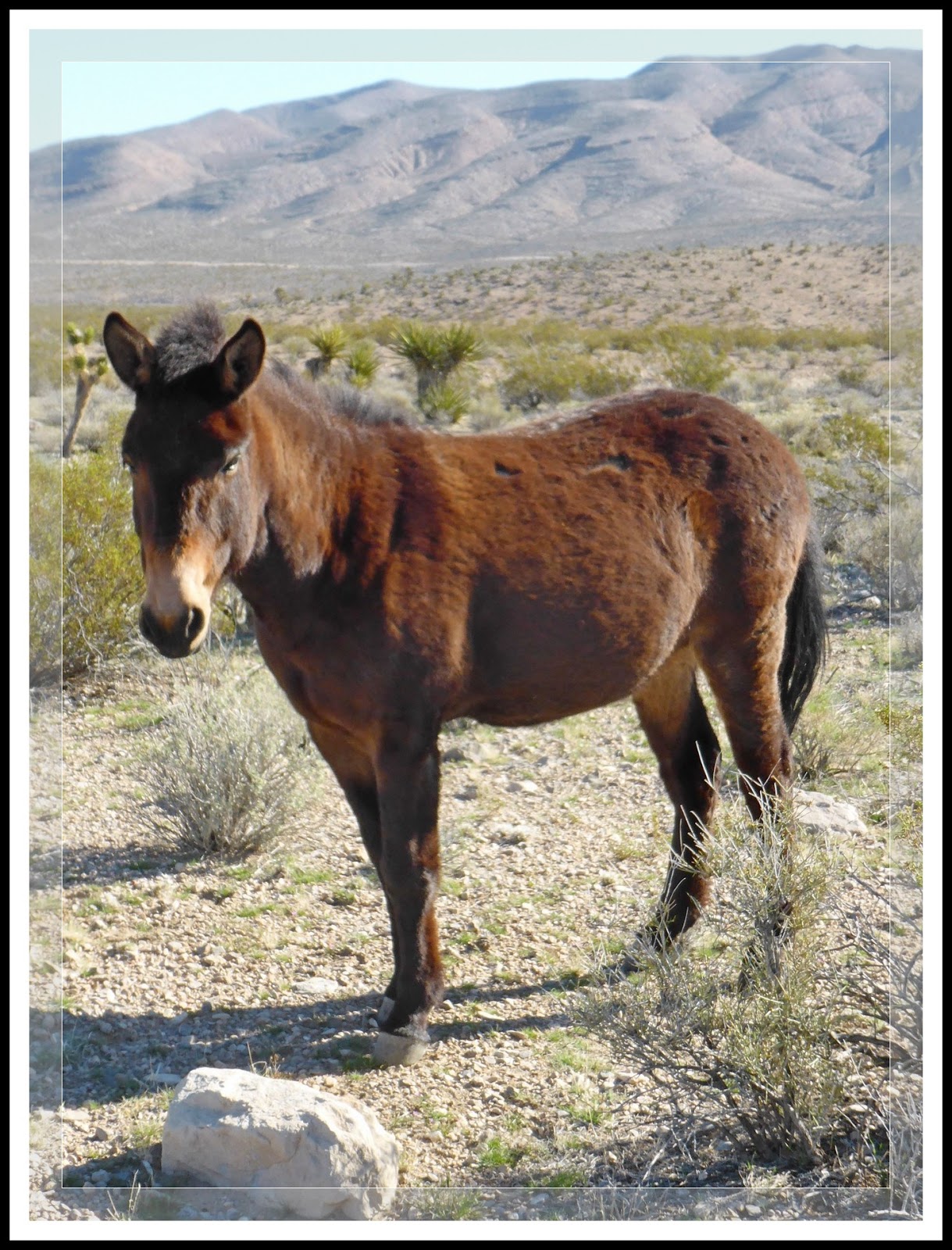
Mule (Equus Mule)


(Fig. 01)
Picture Notes: The picture of the Mule in (Fig. 01) was taken on 03/18/2016 while hiking around Goodsprings Valley behind the town of Goodsprings, Nevada.  The pictures of wild Burro in (Fig. 02) was captured on a drive through Red Rock Canyon Park. For more on these Burros go to ... Wild Burro (Donkey) - (Equus - asinus).


Description: Because Mules do not constitute a species, there is no scientific name for mules as a species. The reason mules are not considered a species is because mules do not reproduce - they are hybrids, the offspring of a male donkey (called a jack) and a female horse (called a mare). Mules are almost always sterile (except that, on rare occasions, a female mule can be fertile).
Mules inherit desirable qualities from both donkeys and horses; from the horse they inherit strength and stamina, and like donkeys, mules are generally patient, sure-footed, intelligent and have an even temper. Donkeys have long ears, a short thick head, a short mane, thin limbs and narrow hooves (Fig. 02). Mules share these characteristics with donkeys but they are larger and taller than donkeys. The physical characteristics that mules share with horses include shape of the body, a uniform coat, and teeth (Fig. 01). The hooves of a mule are harder than those of a horse. The coat of a mule is usually brown (sorrel). Mules have longer ears than horses but usually somewhat smaller than donkey.

Mules have several advantages. Mules have tougher and less sensitive skin than horses. They can live as high as 50 years when compared the the horse's 30-ish years. They need less food, pound for pound, than horses due to a much more efficient digestive tract. Pound for pound mules are also stronger than horses and have a better stamina and agility. Because they are typically much larger than donkeys, they can carry a greater weight. Mules don't spook as easy as horses do and have a strong "self preservation" sense making them a better companion in a fight with wild animals. Finally, mules endure heat and lack of water much better than horses, and are built more for desert life.

Major differences between a wild burro (Donkey) (Equuis asinus) and a Mule: The main difference between a donkey, mule, and a horse is genetics. Beyond the genetic difference, you can easily tell the difference between a donkey and a mule by a few different physical markers. The easiest thing to spot is that mules are usually larger than donkeys (often significantly so), much more closely resembling a horse in size. Another easy difference to spot is that, in the summer, a mule’s coat tends to more closely resemble a horse’s, rather than the longer, coarse hairs of a donkey. However, in winter mules tend to develop coats that more closely resemble a donkey. Besides physical and genetic differences between a mule and a donkey, you can also tell the difference just by hearing them make noises. Donkeys make a very distinctive hee-haw type sound. Mules make a sound that is something of a cross between a horse’s whinny and the donkey’s hee-haw, often starting as a whinny and melding into a hee-haw.
                  

Friday

Wild Burro (Equus asinus) – Red Rock Canyon

{Click on any image to view full size, then use the back button on your browser to return to this page}
EFP-P1080033
(Fig. 01)
09/17/2014 Trip Notes: Out of the dozen times that I have visited this area, I have only spotted burros on three occasions. I attribute the fact that we spotted 6 burros on today’s trip to the time of day. I don’t think I have ever visited this area this close to sunset before. We spotted these burrow along Blue Diamond road as we were headed back to highway 160 on our return home. I'm not sure if this is breeding season, but the burro in (Fig. 01) appeared rather young. Notice that the burro on the left in (Fig. 04) appears to be pregnant.
                         
EFP-P1080023
(Fig. 02)
EFP-P1080030
(Fig. 03)
EFP-P1080026
(Fig. 04)

_________________________________________________________________
EFP-P1070737
(Fig. 05)
08/09/2014 Trip Notes: I spent the morning hiking trails in Willow Springs Canyon taking pictures of petroglyphs and pictographs. On my way out of the park, I came upon this lone burro (Fig. 05) munching on the grass. Luckily, I was able to work my way around him to capture a picture with the mountains in the background (Figs. 06 & 07), before he scampered off. In all of my visits here, this is only the second burro sighting I have had inside the park, the first being about eight years ago.
          
EFP-P1070743
(Fig. 06)
EFP-P1070742
(Fig. 07)

Tuesday

Wild Burro (Equus asinus) - Goodsprings Valley

EFP-P1070058
(Fig. 01)
03/17/2014 Trip Notes: On a trip exploring the Goodsprings Valley behind the town of Groodsprings, I came upon a small band of Burros while hiking up Pauline Mine Road (Figs. 01-03 below). (Click on picture to enlarge)  Using the maximum telephoto setting on my camera, I was eventually able to capture several close-up pictures before they decided to scamper off into the desert. I especially like the family portrait in (Fig. 03).
                              
EFP-P1070064
(Fig. 02)
EFP-P1070139
(Fig. 03)
Description: Wild Burro (Donkey) (Equus asinus). There is no formal cutoff between the terminology "donkey," "burro" and "ass". A small donkey is sometimes called a burro (from the Spanish word for the animal). Burros grow to be about half the size of a horse and weigh between 400 and 600 pounds. Burros also "bray" instead of "whinny". Males are called jacks, and females are called jennies. The differences between horses and burros are generally easy to see. Burros have longer ears and short manes and tails. Babies are born once per year usually between March and July. In the wild, mountain lions are the only natural predator. Nevada is home to most of the nation's wild burros.

Sunday

Wild Burro (Equus asinus) - Bare Mountains, Beatty Nevada

EFP-P1050212
11/18/2013 Trip Notes: As I was exploring the eastern side of the Bare Mountains, just south of Beatty Nevada, in an area once known as the Fluorine District, a.k.a. Bare Mountain District, when I came upon two small bands of Burros, as seen in (Figs. 02-04 below). (Click on picture to enlarge)  Using the maximum telephoto setting on my camera, I was eventually able to capture several close-up pictures (Figs. 01, 05 and 06)) before they decided to scamper off into the desert. I especially like the family portrait in (Fig. 06).
EP-P1050196 EP-P1050208 EP-P1050200
Description: Wild Burro (Donkey) (Equus asinus). There is no formal cutoff between the terminology "donkey," "burro" and "ass". A small donkey is sometimes called a burro (from the Spanish word for the animal). Burros grow to be about half the size of a horse and weigh between 400 and 600 pounds. Burros also "bray" instead of "whinny". Males are called jacks, and females are called jennies. The differences between horses and burros are generally easy to see. Burros have longer ears and short manes and tails. Babies are born once per year usually between March and July. In the wild, mountain lions are the only natural predator. Nevada is home to most of the nation's wild burros.
                    
In fiscal year 1988 the estimate was 1,318 burros, which has grown significantly since then. Wild burros can quickly overpopulate an area. They have long life spans and are not very susceptible to predation or disease. Left unchecked, wild burro numbers can double in four years. That can severely impact desert rangelands with scattered, small water sources like we have in Nevada. To bring wild horse and burro numbers in balance with the available food and water, BLM gathers hundreds of excess wild horses and burros from Nevada ranges every year. Once captured, excess animals are transported to BLM corral facilities where they are vaccinated to prevent illness or disease and given lots to eat and drink. BLM also assigns each animal a unique number – or freeze mark. Once they are ready, they are made available for adoption through BLM’s Adopt-A-Burro Program.
                  
The burro prefers Indian rice grass and four-wing saltbush, but will eat whatever it can to survive. During the hot summer months, the burros are usually within two miles of water, especially females with young foals. As fall approaches, the burros disperse and are found at the higher elevations and up to six miles from water. Wild burros have been known to walk 15 miles without water and then drink five gallons in two and a half minutes, a capability surpassed only by the camel.
EFP-P1050203
EFP-P1050216-2

Wednesday

Wild Burro (Donkey) (Equus asinus) - Tonapah Nevada

E-P1000439
(Fig. 01)
08/02/2012 Trip Notes: On a roadtrip to Lake Tahoe to visit family, I was driving just 15 miles south of Tonapah, Nevada, when I spotted these half-dozen wild burros (Donkey) grazing only about 70 feet away from the west side of the US-95 highway. By the time I stopped, grabbed my camera and began to approach them, they spooked and ran more than 200 hundred yards away before they stopped and returned a gaze back in my direction. These handheld shots were taken with my 200mm telephoto lens. Over the past 10 years I have passed this area more than a dozen times and have never spotted even one of these animals, let along a herd of six. As a result, I feel that the prospect of sighting a band of wild burros in their natural, historic habitat to be quite rare, and therefore felt quite privileged. Because they tend to be very observant, they don’t let people get very close to them.
                        
E-P1000434Description: Wild Burro (Donkey) (Equus asinus). A donkey is the descendant of the African wild ass (of which there are only about 500 left in the wild today). Donkeys are a different species than a horse, but in the same family. They were originally bred in Egypt or Mesopotamia around 5,000 years ago. There is not a formal cutoff between the terminology "donkey," "burro", "mule" and "ass". A small donkey is sometimes called a burro (from the Spanish word for the animal). Burros grow to be about half the size of a horse and weigh between 400 and 600 pounds. Burros also "bray" instead of "whinny". Males are called jacks, and females are called jennies. The differences between horses and burros are generally easy to see. Burros have longer ears and short manes and tails. Though those in these pictures appear to meet this criteria, I have yet to find any pictures on the Internet of an all black burro. Babies are born once per year usually between March and July. In the wild, mountain lions are the only natural predator. Nevada is home to most of the nation's wild burros. In fiscal year 1988 the estimate was 1,318 burros, which has grown significantly since then. Wild burros can quickly overpopulate an area. They have long life spans and are not very susceptible to predation or disease. Left unchecked, wild burro numbers can double in four years. That can severely impact desert rangelands with scattered, small water sources like we have in Nevada. To bring wild horse and burro numbers in balance with the available food and water, BLM gathers hundreds of excess wild horses and burros from Nevada ranges every year. Once captured, excess animals are transported to BLM corral facilities where they are vaccinated to prevent illness or disease and given lots to eat and drink. BLM also assigns each animal a unique number – or freeze mark. Once they are ready, they are made available for adoption through BLM’s Adopt-A-Burro Program.

Wild burros evolved in the deserts of northern Africa and parts of Asia. They adapted to hot, dry summers, cold winters and marginal food sources. These traits combined with physical strength made the burro a useful pack animal. Burros were first brought to the "New World" by early Spanish explorers and were used by prospectors and sheep herders. The burro prefers Indian ricegrass and four-wing saltbush, but will eat whatever it can to survive. During the hot summer months, the burros are usually within two miles of water, especially females with young foals. As fall approaches, the burros disperse and are found at the higher elevations and up to six miles from water. Wild burros have been known to walk 15 miles without water and then drink five gallons in two and a half minutes, a capability surpassed only by the camel.
                     
E-P1000441