 |
Originally posted in 2001, I recently updated this page in 2015. Though Death Valley can be famous for spectacular, spring wildflower displays, they are the exception. It is always very difficult to judge when it is going to be a good year for wildflowers at Death Valley National Park. Only under perfect conditions does the desert fill with a sea of gold, purple, pink or white flowers. A good wildflower year depends on at least three things: well-spaced rainfall throughout the winter and spring; sufficient warmth from the sun; and the lack of drying winds. The good news is that even though there are years where blossoms are few, they are never totally absent.
Most of the showy desert wildflowers are annuals, also referred to as ephemerals because they are short-lived. Oddly enough, this limited lifespan ensures survival here. Rather than struggle to stay alive during the desert’s most extreme conditions, annual wildflowers lie dormant as seeds. When enough rain finally does fall, the seeds quickly sprout, grow, bloom and go back to seed again before the dryness and heat returns. By blooming enmasse during good years, wildflowers can attract large numbers of pollinators such as butterflies, moths, bees and hummingbirds that might not otherwise visit Death Valley.
During some of my earlier visits I was able to obtain a few pictures (2010 visit), however there was almost nothing worth stopping for on my 2011 visit. Now in our 12th year of a sustained drought, things seem even worse than in some of my earlier visits. However in 2015, even after arriving 2-3 weeks late for the best wildflower viewing, I still managed to find a few shots worth capturing. For more information on desert plants and flora, go to my index on plants and flowers at ... Plants & Flowers - Index.
_________________________________________
|
| The Desert Five Spot |
 |
I captured these pictures during my 04/11/2010 visit to the park. From what I could tell, it appeared that we might have been just a couple of weeks late. These were captured at the entrance to the wash trail that led to the Natural Bridge Canyon.
Description: Commonly called the desert five spot, this erect annual is also known as falsemallow, lantern flower, Chinese lantern, and fivespot mallow. (It may also be listed as Malvastrum rotundifolium in some publications.) The plants are usually less than a foot high. The showy flowers are rose-pink with five purplish or deep-red spots on the insides of the petals. The leaves are often tinged with red or sometimes even completely red. The desert five-spot is found in washes and on mesas below 3800 feet. It grows in the deserts of southern California, Nevada, Arizona, and northern Mexico. Its showy flowers are in bloom between March and May. The best specimens of this flower are likely to be found where there is an abundance of black lava rock. [excerpted from http://www.blackturtle.us/ DV_PLANTS/FIVESPOT/index.html] |  |
|
______________________________________
Desert Sand Verbina (Abronia villosa) |
 |
This beautiful annual was captured on this year’s 03/19/2011 visit. These were taken around the Lake Manly marker and turnoff along the western side of Badwater Road.
Description: This annual spreads along the ground in an almost vine-like fashion. Many flower clusters of bright pink make this a highly noticed plant. The leaves are slightly hairy and light green. Sand verbena, as the name suggests, is often found around sand dunes and other sandy areas, such as washes, in the desert regions of southern California. This plant is also found in Arizona, Nevada, Utah, and Mexico, as well as along the coast. Showily pink clusters of flowers can be found from February through July. See more at Desert Sand Verbina
|  |
|
_____________________________________
Desert Sunflower (Geraea canescens) |
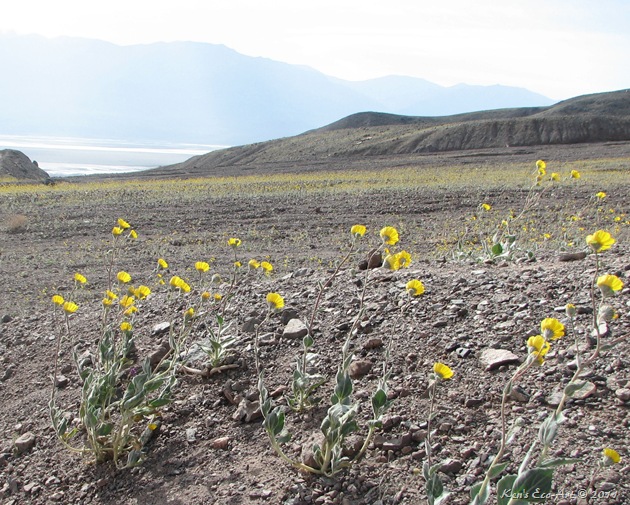 |
There were numerous areas within the park that were covered with sunflowers, probably the most common wildflower in Death Valley.
Description: The Geraea canescens is also known as the desert sunflower, hairy desert sunflower, or desert gold. It is a dicot and annual of the Aster (Asteraceae) family. "Geraea" in its scientific name comes from the Greek geraios ("old man"), referring to the white hairs on the fruits. The desert sunflower has a yellow sunflower-like flower, each flower on a slender, hairy stem. It grows 1-3 feet high. The leaves are gray-green and grow to 3 inches long. It flowers February through May after sufficient rainfall. It is native to western North America, specifically Arizona, Nevada, California, and Utah. A drought-avoiding annual plant, it can be found in the California, Mojave, and Sonoran Deserts. It grows from sea level to 4,265 feet in sandy desert soil in the company of creosote brush. The flowers attract bees and birds. Seeds are eaten by birds and rodents. There are two varieties of Geraea canescens: Geraea canescens var. canescens and Geraea canescens var. paniculata. |  |
|
_________________________________________
|
| Notch-Leaved Phacelia (Phacelia crenulata) |
 |
I captured these pictures during my 03/28/2015 visit to the park. Unfortunately, we were about 2-3 weeks late from what would have been the best viewing for wild flowers. These were captured while hiking along the lower ridgeline at Dante’s View.
|
| Description: Notch-Leaved Phacelia (Phacelia crenulata), a.k.a. Cleftleaf Wild Heliotrope, Scorpionweed, Scalloped Phacelia and Caterpillarweed. It is native to the southwestern United States and northern Mexico. It is an annual plant that grows from 3-24 inches tall. Its open flower clusters, coiled like a scorpion’s tail, are made up of many small, bell-shaped, purple flowers with white or light blue throats that all grow from the same side of the branching flower stalks. Flowers are 1/2 inch wide and have 5 round lobes. The petals of the flowers vary from deep violet to blue-purple in color and up to a half inch long. |
_______________________________________________
Tidy Fleabane (Erigeron concinnus)
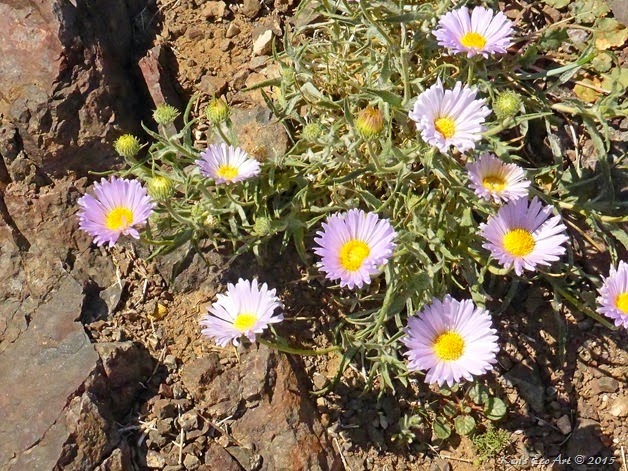
I captured these pictures during my 03/28/2015 visit to the park. Unfortunately, we were about 2-3 weeks late from what would have been the best viewing for wild flowers. These were captured while hiking along the lower ridgeline at Dante’s View.
Description: Tidy Fleabane (Erigeron concinnus), a.k.a. Navajo fleabane and Shaggy daisy, is a perennial flowering plant in the family Asteraceae, native to the dry mountains of the Mojave Desert around Death Valley in southeast California and Nevada. It can also be found in Idaho, Utah, Wyoming, Colorado and New Mexico. “Erigerons”, commonly called "Daisies" or "Fleabanes", are a large and complex genus; there are 130 species in North America and 200 world-wide.
___________________________________________
Smooth Desert Dandelion (Malacothrix glabrata)

I captured these pictures during my 03/28/2015 visit to the park. Unfortunately, we were about 2-3 weeks late from what would have been the best viewing for wild flowers. These were captured in the sandy desert area surrounding the road leading up to Dante’s View.
Description: Smooth Desert Dandelion (Malacothrix glabrata), a.k.a. Desert Dandelion, is an annual forb that grows in sunny, open, sandy washes and flats. Its dandelion-like flower heads are up to 1 3/4 inches wide and have numerous, slender, strap-shaped, square-tipped, 5-toothed corollas. The sparse leaves are green, alternate, mainly basal, and usually pinnately lobed with 3 to 6 or more pairs of long, threadlike lobes.


